
Short answer: To review a Binance Futures liquidation, match the contract, margin mode, price reference and timestamp before comparing prices or charges. Binance’s standard Futures explanation uses Mark Price for liquidation assessment; a last-trade candle, an earlier displayed liquidation estimate and a later history entry are different records. A mismatch alone neither proves an error nor fully explains what happened to the account.
Source review: November 2, 2026. This guide concerns checking a completed event, not choosing leverage or predicting a liquidation price. Product access, account modes and contract rules vary. Binance’s educational FAQs defer to the applicable terms, Exchange Rules, Clearing Rules and contract specifications; those govern an individual case. No personal account, live trade or actual liquidation was tested for this article.
Which price are you comparing?
The first task is to label each number. A chart screenshot can show Last Price while a risk assessment uses Mark Price. Even two numbers called “liquidation price” may refer to an estimate before the event and a history field recorded afterwards. Keep the original field name with its value.
| Field | What it describes | What it does not establish |
|---|---|---|
| Last Price | The contract’s most recent trade; a chart can display this series. | The risk reference at the liquidation event, or the price available for your entire order. |
| Mark Price | A calculated reference used in Binance’s standard Futures liquidation and unrealized-PnL explanation. | A guaranteed execution price. |
| Estimated liquidation price | A displayed estimate based on the position and account state at that moment. | An immutable threshold or a guaranteed closing price. |
| Price in liquidation history | The value recorded in the event’s named history field. | An order-by-order execution breakdown, unless the field’s definition and execution records support that reading. |
Source basis: Binance Futures Liquidation Protocols and Mark Price vs. Last Price. The comparison and evidence limits are Bimence’s explanatory organization, not additional exchange rules.
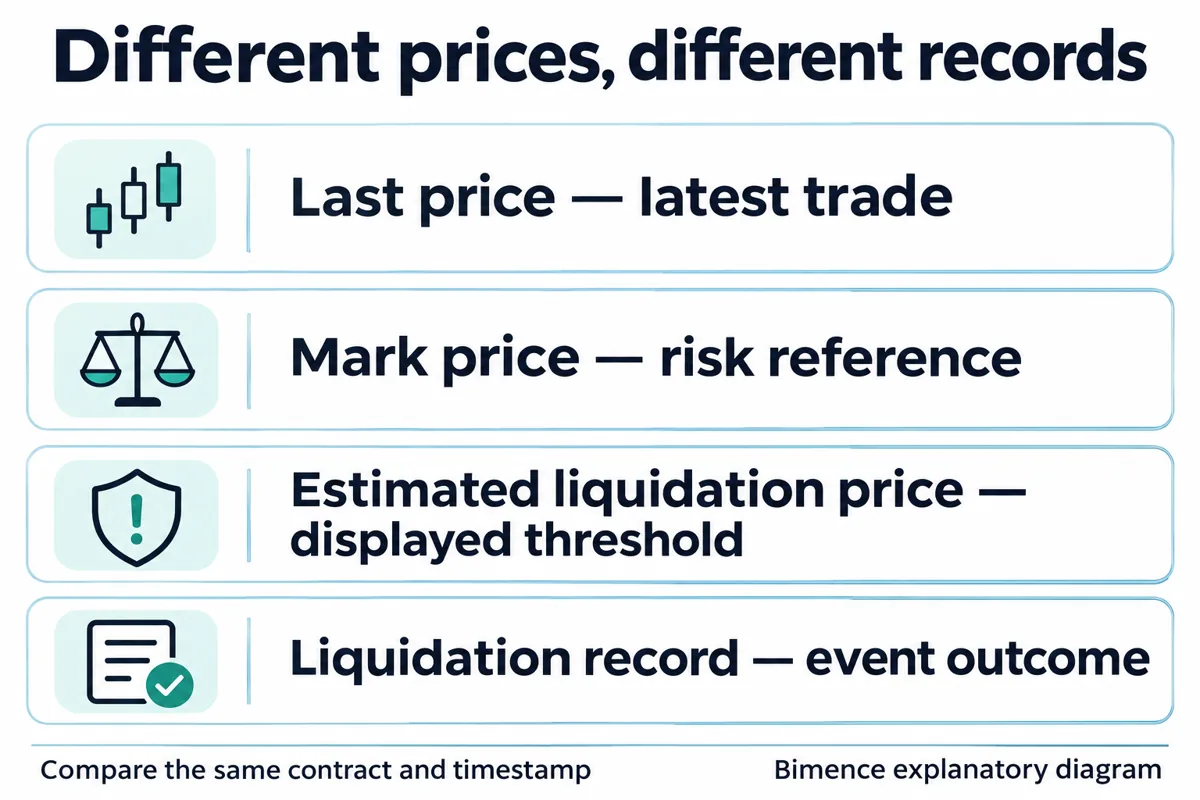
Binance’s protocol explains that fast price changes can produce a difference between a previously calculated liquidation price and the value later shown in liquidation history. That is a possible explanation to investigate, not proof of the cause of every mismatch. A current estimate cannot recreate an earlier account state.
If a record also refers to a bankruptcy price or ADL, treat that as a separate field and process. Do not substitute it for a last-trade candle or assume it is the fill price. The linked protocol explains those processes; this guide does not calculate them.
Build one event record before drawing a conclusion
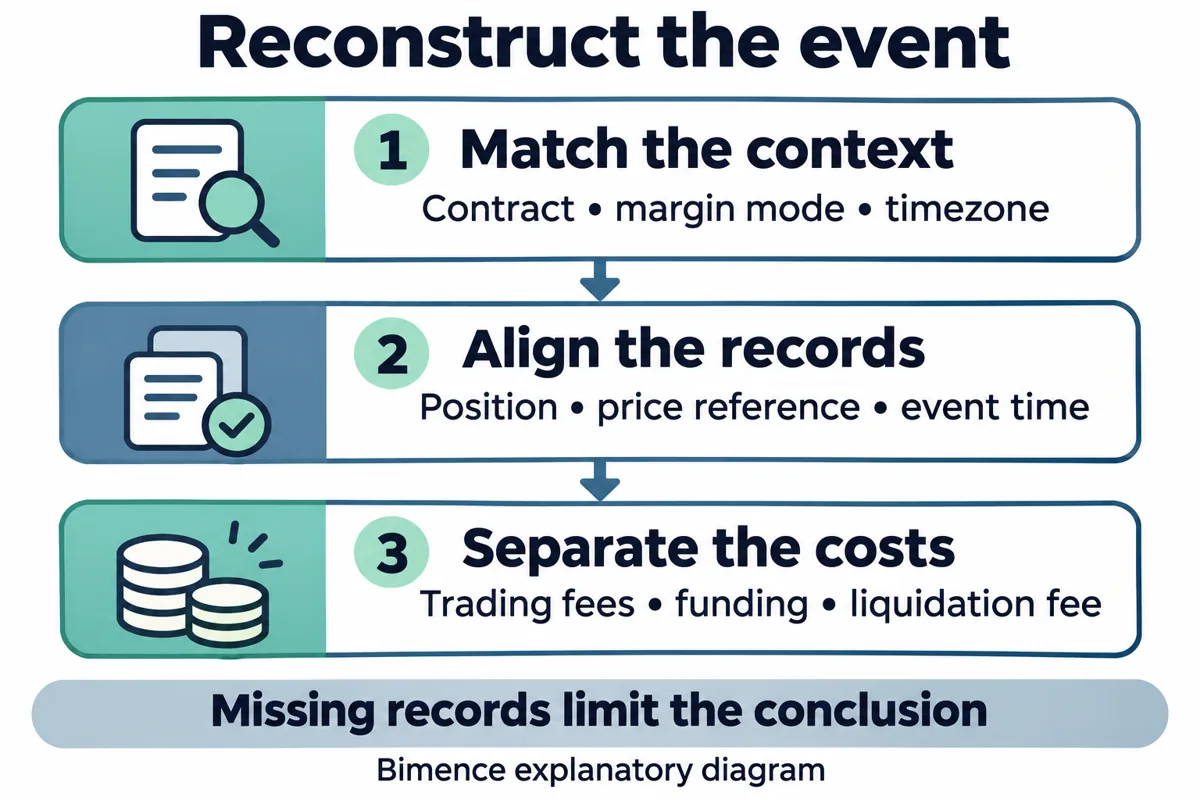
Start with the Futures product and contract involved. Record the exact symbol, USDⓈ-M or COIN-M context, settlement asset, position direction, and margin and position modes shown for the event. Do not use a current setting as evidence of the mode used earlier. For basic screen and position terminology, use the Futures beginner guide.
- Find the event in Futures history. Look for the relevant position or liquidation record in the app or website’s Futures history area. Keep its event time, displayed field names and any order or transaction identifiers. Menu labels and available records can differ by interface and account.
- Align times and filters. Use the same contract and date range in every view. Write down each view’s timezone and timestamp precision before comparing them. A minute candle, a second-level history entry and a later screenshot are not simultaneous observations.
- Check the price reference. Where the interface offers it, distinguish the Mark Price series from Last Price. Keep any historical observation or screenshot intact; today’s chart or estimate alone cannot prove the account’s exact risk state at the earlier instant.
- Separate event and execution evidence. Match the liquidation event to related order and trade records where available. Distinguish an order’s requested quantity from actual fills and any remaining position. A chart touch is not a fill confirmation.
- Collect the balance entries. Identify realized price PnL, trading commission, funding and any liquidation-related charge by their actual row labels, asset and identifiers. Keep transfers or other wallet movements separate.
The transaction-history export guide explains why order, trade and balance records answer different questions. If an older or more precise record is unavailable, record the gap instead of filling it with an estimate.
A hypothetical mismatch: what the numbers can prove
Constructed example, not a Binance account record: assume a linear, USDT-settled short position. Prices below are USDT per unit. All times use UTC, the contract and modes stay the same, and an independently identified liquidation event occurs at 09:00:05. These invented observations demonstrate record comparison only; they do not reproduce Binance’s risk engine or derive a valid liquidation threshold.
- 09:00:00: a screenshot shows Last Price 100.00, Mark Price 100.00 and an estimated liquidation price of 100.50.
- 09:00:05: separate retained observations show Last Price 100.20 and Mark Price 100.60. The event record identifies this second as the liquidation time.
- Afterwards: liquidation history displays a price field of 100.75. The order and trade records still need to be inspected to identify any executions and their quantities.
At the event observation, Mark Price minus Last Price is 100.60 − 100.20 = 0.40 USDT per unit. The later history value minus the earlier estimate is 100.75 − 100.50 = 0.25 USDT per unit. These are differences between named observations, not account losses, liquidation fees or evidence of an incorrect charge.
The example explains why “the Last Price candle did not reach my earlier estimate” is insufficient evidence by itself. It does not establish that the estimate stayed at 100.50, the complete margin state, the engine’s exact trigger instant, or a fill at 100.75. Those conclusions require the corresponding records. The example is consistent with the distinction in Binance’s liquidation explanation; it is not a forecast or an exact liquidation calculation.
Reconcile costs without subtracting them twice
Binance’s Futures fee explanation separates trading commissions, funding and a liquidation-related clearance charge. The fee FAQ uses “Insurance Clearance,” while the liquidation protocol uses “Liquidation Clearance.” Preserve the label actually shown in the account rather than renaming every row or assuming the labels must be identical across interfaces. The protocol also states an exception for a position that is bankrupt following liquidation; do not assume every event has the same clearance charge.
For each row, check the amount, debit or credit sign, asset, timestamp and transaction identifier. Use the actual charged amount when reconciling an event. A current fee rate or a third-party percentage does not prove what was charged earlier. For the distinction between ordinary trading fees and funding, see Futures fees and funding rates.
| Separate entry | Signed amount | Assumption |
|---|---|---|
| Realized price PnL | −12.00 USDT | Gross of the three debits below. |
| Trading commissions | −0.40 USDT | Combined commissions included once. |
| Funding debit | −0.10 USDT | A confirmed debit for this example. |
| Liquidation-related charge | −0.50 USDT | A separately listed charge, assumed to apply. |
| Net change | −13.00 USDT | No other balance movements. |
Bimence calculation: −12.00 − 0.40 − 0.10 − 0.50 = −13.00 USDT. With an assumed starting balance of 50.00 USDT, the corresponding ending balance is 37.00 USDT. If the funding row were instead a 0.10 USDT credit, with everything else unchanged, the net change would be −12.80 USDT and the ending balance 37.20 USDT. A positive funding entry would not make the overall event profitable.
This arithmetic applies only to the stated single-asset ledger. If an exported PnL figure already includes a fee, do not subtract that fee again. Do not add BNB, BTC and USDT amounts as though they were one unit, or treat this as a COIN-M, Portfolio Margin or multi-asset valuation formula. Missing rows, transfers, conversion values or a different reporting convention must be resolved before claiming a full balance reconciliation.
Check a stop order separately from the liquidation
If a stop order is part of the question, retain its selected trigger reference, status, quantity and any fills. Compare its timestamps to the event record rather than assuming the chart used the same reference. A trigger condition does not establish successful execution; an unfilled limit order and a completed closing trade are different outcomes. Binance’s Futures order-type explanation distinguishes stop-limit orders and TP/SL trigger references.
Product boundaries matter. The Spot stop-limit and OCO guide describes Spot orders, not a promise of Futures protection. Likewise, Isolated versus Cross Margin concerns borrowed-asset Margin. Neither should be used as the liquidation formula for a Futures or portfolio account.
What to preserve when the records still do not reconcile
Keep the exact contract and modes, event time with timezone, original field labels, available price observations, order and trade identifiers, and separately identified balance entries. State what is missing and the specific mismatch: for example, an unexplained debit or a history timestamp outside the selected export range. Preserve original records privately and redact sensitive details from anything posted publicly.
Use Binance’s official support channel for an account-specific review. A public price chart cannot independently reconstruct all internal risk inputs or establish a refund entitlement. Bimence does not access the account, reverse a liquidation, guarantee a support outcome, or request passwords, one-time codes, API secrets or recovery phrases.
Official sources and review scope
- Binance Futures Liquidation Protocols — updated January 4, 2026; checked November 2, 2026. Price references, history-price discrepancy, liquidation process and clearance-charge conditions.
- Mark Price vs. Last Price on Binance Futures — August 21, 2025; checked November 2, 2026. Distinct price roles and switching chart references.
- What Fees are Generated in Binance Futures Trading? — updated January 5, 2026; checked November 2, 2026. Separate commission, funding and clearance categories.
The FAQs identify themselves as educational material that may be outdated and point to the governing Exchange Rules, Clearing Rules, applicable terms and contract specifications. Use the rules applicable to the account and event date; this article is not a legal interpretation or a full audit of those documents.
Risk and independence: Futures can produce rapid, substantial losses and liquidation; availability depends on account and region. This is general education, not individualized trading, investment, legal or tax advice. Bimence is independent of Binance and may receive affiliate commissions through links elsewhere on the site. The examples do not promise recovery, protection or a referral benefit. See the Risk Disclosure, Affiliate Disclosure and About & Editorial Policy.